CLEAR DETAILS. SIMPLE CHOICES.A LITTLE SPACE FOR YOUR NEXT CHAPTER ↗
Don’t Make Me Think
Cover of Player Experience Design in 20 Minutes (Coffee Break Series) FROM THE BOOK CATALOGUE

Game Design

Player Experience Design in 20 Minutes (Coffee Break Series)

By Kenwright

A concise guide to understanding and shaping the emotional and cognitive journey players experience inside your game.

WHAT THE PUBLISHER HIGHLIGHTS

  • Learn how players perceive and interpret game systems.
  • Identify common UX pitfalls that cause early player drop‑off.
  • Understand motivation, flow, and emotional pacing.

Opens www.amazon.com. Check the retailer for current prices, formats, delivery, and availability.

Catalogue reference: 1324c5639e187d0e

INSIDE THE BOOK

About this book

Player Experience Design in 20 Minutes breaks down the core principles behind what makes games feel intuitive, satisfying, and emotionally resonant. From onboarding and flow to feedback loops, motivation, and cognitive load, this book distills the essentials of UX and player psychology into a fast, approachable format. Whether you're a solo developer or part of a larger team, you'll learn how to identify friction points, craft meaningful interactions, and build experiences that keep players engaged far beyond the first few minutes.

From the publisher’s description

  • Learn how players perceive and interpret game systems.
  • Identify common UX pitfalls that cause early player drop‑off.
  • Understand motivation, flow, and emotional pacing.
  • Apply practical techniques to improve clarity, feedback, and engagement.

Explore the topics

ANOTHER PERSPECTIVE

Readers, in their own words

Explore reviews
Reader review5

Excellent from start to finish

Excellent from start to finish. No filler, no padding.

There is a particular kind of technical book that is dense without being difficult, and this is one of them. The code samples assume a particular environment, which took a bit of fiddling to get running properly. The book rewards careful reading. Skimming it would be a mistake. This is the book I wish had existed when I started working with game design.

Lucas LewisBioinformatics researcher · Warsaw, PL
Player Experience Design in 20 Minutes
Reader review3

Not quite what I expected

Some sections were excellent and others felt like filler.

I had been on the fence about this one for a while, and I should have bought it sooner. The code samples assume a particular environment, which took a bit of fiddling to get running properly. Some of the material is available elsewhere, but rarely presented this clearly. The exercises at the end of each chapter are worth doing — they caught a few misconceptions I did not know I had. Fine, but there are stronger books on the same subject if you look around.

Anya PetersonFull-stack developer · Mumbai, IN
Player Experience Design in 20 Minutes
Reader review5

Finally, an explanation that clicks

The clearest explanation of game design I have come across.

There is a particular kind of technical book that is dense without being difficult, and this is one of them. The chapters on game design are the strongest — the examples are stripped down but complete, and I could follow along without constant guessing. I found myself making notes in the margins, which is always a good sign. I have already recommended it to two colleagues and will recommend it to more.

Andrew MurphySecurity researcher · New York, NY
Player Experience Design in 20 Minutes

BEYOND THE BOOKSHELF

News & ideas

More to explore

THE BOOKS

The details, at a glance

View all books
Cover of 7-7-7 Rule for Game Design (Paperback)
Game Design

7-7-7 Rule for Game Design

A practical framework that helps game creators shape mechanics and player experiences with clarity and confidence.

Learn a clear framework for structuring game ideas.

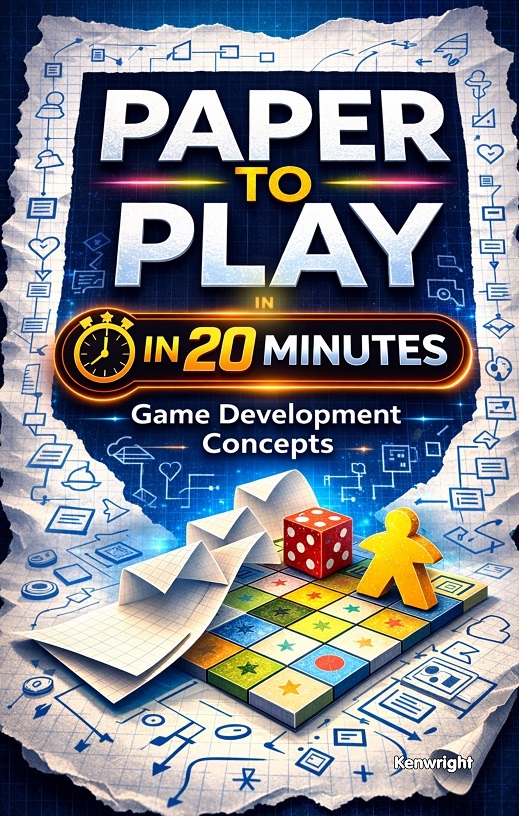
Cover of Paper to Play in 20 Minutes: Rapid Game Prototyping (Game Development Concepts)
Game Development

Paper to Play in 20 Minutes

A hands-on guide to transforming game ideas into playable prototypes in just 20 minutes, focusing on rapid iteration and creative exploration.

Transform abstract game ideas into testable prototypes quickly.

FIND A BOOK. SKIP THE MAZE.

Start with the synopsis and the topic list; keep your comparison simple.

Explore the catalogue